
Tools
Do geomagnetic disturbance levels really matter?

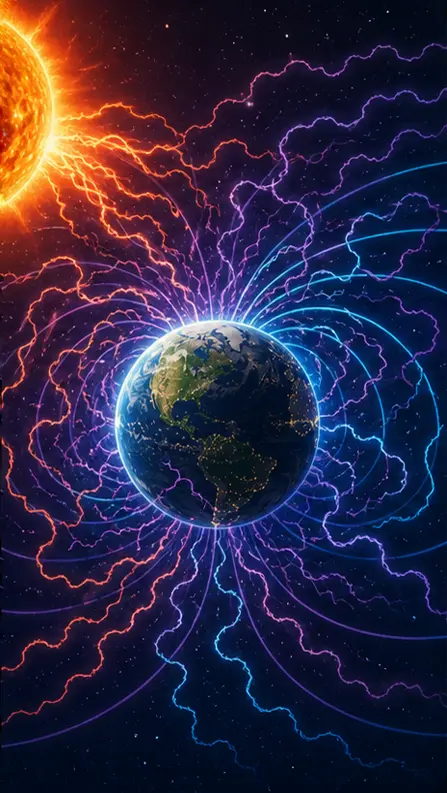


Solar flares and coronal mass ejections (CMEs) regularly affect Earth's magnetic field; when disturbances are strong, they cause the Northern Lights, and can even interfere with GPS and other electronics systems.
What about remote viewing? It gets worse, measurably, while the field is disturbed — and that is not folklore. Joseph McMoneagle, Remote Viewer #001 of the Army unit that became Project STARGATE and a Legion of Merit recipient for the intelligence work he did with it, gives the finding a section of his own book.
…when geomagnetic fluctuations are lowest, they are lowest at the same time the LST shows good remote viewing is assumed to be taking place. — Joseph McMoneagle, Remote Viewing Secrets, p. 172
He reports the correlation confirmed across 2,879 free-response trials measured against the ap index, and adds the part that changes how you plan a session: it concentrates near 13 hours local sidereal time — the same window the sidereal clock tracks. A quiet field and the right window are the same advice arriving twice.
During a geomagnetic "storm," it may feel like nothing is coming through, or that the target is "blank" or "empty."
NeoARV will alert members who are using the system during such times.
K and Kp are 0–9 readings for geomagnetic disturbance. Local K is from the nearest measuring station to your location. Planetary Kp combines stations worldwide. Lower is calmer.
| K / Kp | Condition | Expected RV interference |
|---|---|---|
| 0-1 | Quiet | Negligible |
| 2 | Threshold | Possible |
| 3 | Mild | Moderate |
| 4-5 | Active | Strong |
| 6+ | Storm | Very Strong |
Research sources
Spottiswoode, S. J. P. (1997). Geomagnetic fluctuations and free response anomalous cognition: A new understanding. Read the paper.
Persinger, M. A., & Schaut, G. B. (1988). Geomagnetic factors in subjective telepathic, precognitive, and postmortem experiences. Journal of the American Society for Psychical Research, 82, 217–235.
Tart, C. T. (1988). Geomagnetic effects on GESP: Two studies. Journal of the American Society for Psychical Research, 82, 193–215.
McMoneagle, J. (2000). Remote Viewing Secrets: A Handbook. Hampton Roads Publishing. Chapter Eleven, pp. 167–172; the Spottiswoode paper above is reprinted in full as Appendix C.
The fuller reference list, and what McMoneagle actually says about all of this, is on Knowing When Not to View.
About this time window
Remote viewing performance tracks a clock most people have never heard of. Not the one on your wall — a star clock, set by your longitude and the earth's turn against the sky, which drifts about four minutes a day out of step with ordinary time.
Across 1,468 free-response trials, sessions run within an hour of 13.5 hours local sidereal time came in at nearly three and a half times the effect size of the rest. An independent set of 1,015 trials came in higher still. Joseph McMoneagle — Remote Viewer #001 of the Army unit that became Project STARGATE, decorated with the Legion of Merit for the intelligence work he did with it — calls that discovery astounding, and does not leave it at that.
…if you are interested in doing good remote viewing, you should be paying attention to Local Sidereal Time. — Joseph McMoneagle, Remote Viewing Secrets, p. 170
He reprints the whole paper at the back of his own book, and he is straight about the part nobody can explain: whether where we sit relative to the galaxy has anything to do with it, he says, no one knows. The correlation is on the record. The mechanism is not, and pretending otherwise would be the only dishonest thing here.
The green band on the clock is that window, converted from sidereal time into your local time, for where you are standing right now.
Window: 30 minutes before to 30 minutes after the star-based time reported in the source research.
Research sources
Spottiswoode, S. J. P. (1997). Apparent association between effect size in free response anomalous cognition experiments and local sidereal time. Journal of Scientific Exploration, 11(2), 109-122.
Spottiswoode, S. J. P., & May, E. C. (1997). Anomalous cognition effect size: Dependence on sidereal time and solar wind parameters.
McMoneagle, J. (2000). Remote Viewing Secrets: A Handbook. Hampton Roads Publishing. Chapter Eleven, pp. 167–172; the 1997 paper above is reprinted in full as Appendix B.
The geomagnetic half of the same story — and why the two windows overlap — is on Knowing When Not to View.